
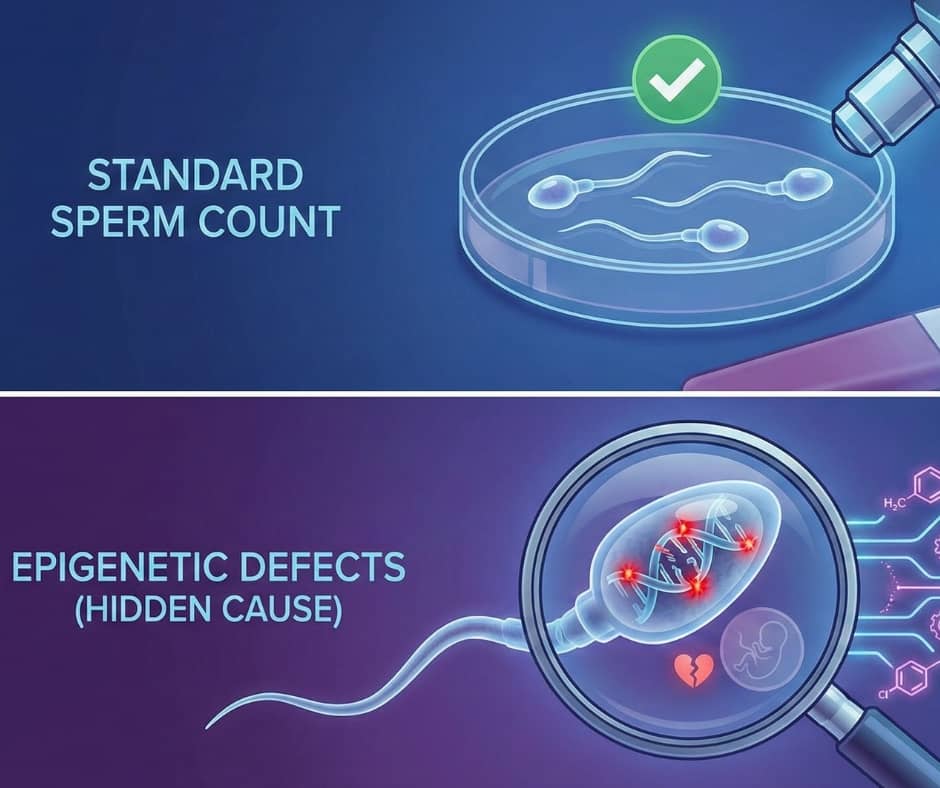
When Standard Results Are Not Enough
We need to talk about a major blind spot in fertility. Picture a couple sitting in a clinic after their third miscarriage. The female partner has likely been through the medical wringer with hormone panels and ultrasounds to find a reason. Meanwhile the male partner handed over a sample once, received a result that said his count was within the standard range, and was essentially told he was fine.
But being told you are fine might be wrong. This is especially frustrating for couples who thought they had covered all their bases with standard premarital screening.
For years we have treated male fertility as a numbers game. If the sperm are swimming and there are enough of them we assume the job is done. Emerging science is flipping this script. We now know that a man can have a robust sperm count and still be the primary driver of pregnancy loss. It turns out the male factor is often the invisible force behind unexplained miscarriages.
The Courier and the Package
Let’s break this down with a simple analogy. Think of a sperm cell as a courier delivering a package. The package is the DNA which serves as the blueprint for a future child.
A routine semen analysis is like checking the courier’s van. Is it moving fast enough? Are there enough vans on the road? Does the van look undamaged? If the answer is yes then we mark the result as normal.
But standard testing completely ignores the package inside the van.
This is exactly what researchers highlighted in a groundbreaking study published in the Asian Journal of Andrology in late 2025. They looked at a group of men who were survivors of Hodgkin’s Lymphoma. These men had recovered from their treatment and their sperm counts were back to typical levels. By all traditional metrics they were fertile. Yet they were experiencing a high rate of recurrent spontaneous miscarriage.
The study revealed that chemotherapy had left epigenetic scars on the sperm DNA. The sperm could swim and fertilise the egg without issue but the instruction manual inside was corrupted. Specifically the methylation patterns were disrupted. This meant that later down the line when the embryo tried to build the placenta the instructions failed and led to a miscarriage.
It Is Not Just About Chemotherapy
You might be thinking that because you haven’t had chemotherapy this doesn’t apply to you. But here is where it gets relevant for everyone.
The mechanism discovered in that study involves DNA fragmentation and epigenetic scarring. This is not unique to cancer survivors. It is a biological red flag that can be triggered by everyday life.
The Lifestyle Link
Your sperm DNA is surprisingly sensitive. We are already asking if we are facing a reproductive health crisis in Singapore due to modern pressures. Oxidative stress from smoking or obesity can cause breaks in the DNA strands similar to the damage seen in clinical studies. It is silent damage because you won’t feel it and a standard microscope won’t show it. Even advanced paternal age plays a role in decreasing the integrity of that genetic payload.
The Infection Connection
Then there is the issue of infection. We often think of STIs as just an uncomfortable nuisance but they can be fertility wreckers. While we know about STDs that damage a woman’s fertility, bacterial infections in men can trigger inflammation in the reproductive tract which effectively damages the DNA payload.
This is why visiting an STD clinic is a smart fertility strategy. Conditions like chlamydia or gonorrhoea can hang around without symptoms and quietly erode sperm quality. Regular STD testing is one of the easiest ways to protect your genetic legacy. The same goes for viral risks. Comprehensive HIV testing and hepatitis screening ensure you aren’t passing on complications that could affect your partner or pregnancy.
The Hormonal Engine
We also cannot ignore the engine driving the whole process. Testosterone isn’t just about muscle and libido as it regulates sperm production. If your levels are off then the quality of your sperm can suffer. If you have been feeling sluggish or just off then an Androgen Deficiency test can tell us if your hormonal engine needs a tune-up.
So What Do We Do About It?
The era of relying on a simple head count of sperm is ending. We need to look deeper into the biological engine that produces it.
If you are facing recurrent miscarriages or unexplained infertility you need to assess the environment in which your sperm is being produced.
At Shim Clinic we offer the Fertility Screen (IQFS03). This profile analyses the critical hormones that dictate sperm quality and production including FSH, LH, and Testosterone. By ensuring your hormonal axis is balanced we can identify hidden issues that a microscope might miss.
You can find out more about this targeted hormonal profile on our Fertility Screen (IQFS03) page.
Rewriting the Narrative
We need to stop viewing miscarriage as solely a female issue. The science is clear that men play a massive and often silent role. But this isn’t about assigning blame. It is about empowerment.
Knowing that the male factor exists opens up new doors. It means there are more tests we can run and more variables we can fix to improve the chances of a successful pregnancy. Whether it is treating a hidden infection or balancing hormones the answers are often there if you know where to look.
Ready to get the full picture? If you have questions about fertility or want to move beyond basic testing the team at Shim Clinic is here. From targeted men’s health checks to hormonal analysis we can help you find the answers you need.
References:
- Asian Journal of Andrology: Recurrent spontaneous miscarriages from sperm after ABVD chemotherapy in a patient with Hodgkin’s lymphoma
- PubMed Central: Sperm DNA and methylation profiling in survivors