
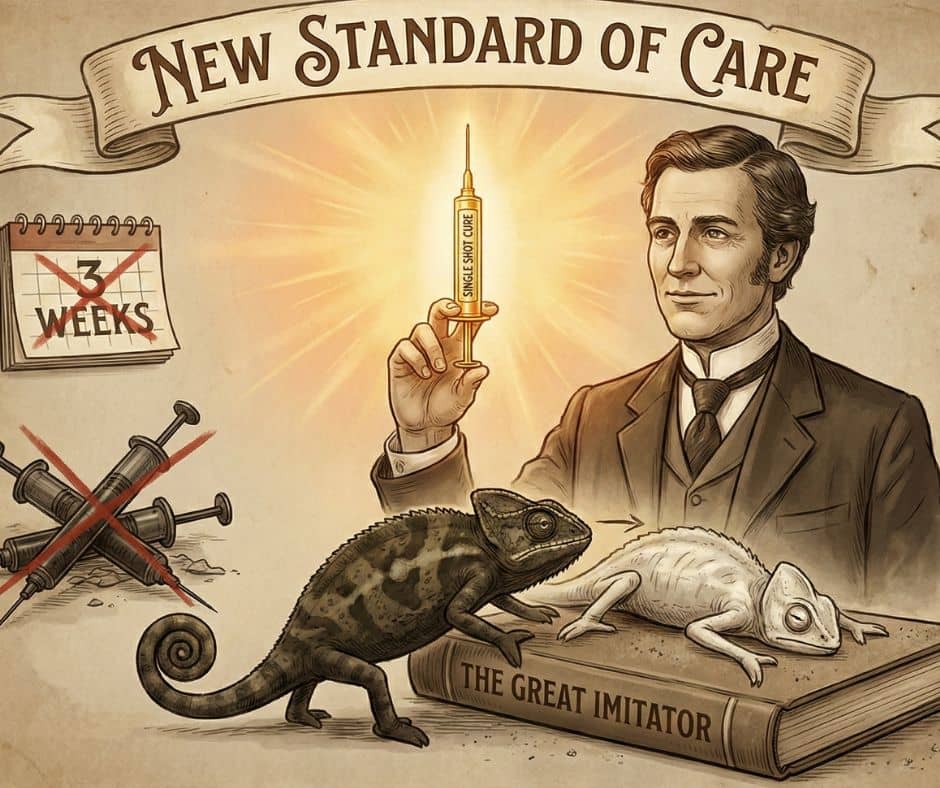
Syphilis is a ghost of a disease that has haunted humanity for centuries. Despite having a known and curative treatment for over eighty years, it is currently staging a terrifying global comeback. In the United States alone, health authorities reported over 209,000 cases in 2023. This is the highest incidence since the 1950s and represents a staggering 61% increase since 2019. Known to clinicians as the great imitator for its ability to mimic almost any other medical condition, this infection can infiltrate virtually every organ system if left unaddressed.
In the context of a busy std clinic in singapore, we often encounter patients in the latent phase. This is the period where the patient feels perfectly fine and shows no visible symptoms like the painless chancres of the primary stage or the distinctive rashes of the secondary stage. The infection is essentially hiding and is only detectable through serological reactivity. For decades, the medical rule of thumb has been that if the infection has lasted more than a year or is of an unknown duration, the patient must endure a grueling multi-dose regimen. This usually involves 7.2 million units of benzathine penicillin G administered as three separate weekly injections. However, as we move through 2026, a massive wave of new data suggests this three-dose dogma is an unnecessary burden for the vast majority of patients.
The Biology of a Slow Motion Pathogen
To understand why we have been over-treating syphilis for so long, we must look at the unique and almost lazy pace at which Treponema pallidum operates. Unlike common bacteria that can double their population in minutes, the syphilis spirochete is exceptionally sluggish. It takes roughly 30 to 33 hours to divide just once. Because penicillin exerts its bactericidal effects only while the bacterium is actively synthesizing a new cell wall during division, the drug must remain in the host’s system for a prolonged period to ensure it catches every organism as it eventually replicates.
This biological reality led to the Collart Hypothesis in the mid-20th century. This theory suggested that in late-stage syphilis, the bacteria might enter a quiescent or completely dormant state where they divide at even longer intervals. This idea became the bedrock of modern treatment guidelines. It was believed that to be absolutely safe, a clinician must maintain penicillin concentrations in the blood for a full 21 days without any interruption. Achieving that precise 21-day window required exactly three separate doses of long-acting penicillin spaced one week apart. This was maximum force medicine designed out of a historical fear of under-treatment rather than modern and robust clinical trials.
A Legacy of Fear and Overcompensation
The medical community’s attachment to the three-dose regimen is also deeply rooted in a dark history of ethical failures. The most notable of these is the Tuskegee study in the United States where curative penicillin was deliberately withheld from infected men for decades. When these horrors were exposed in the 1970s, the resulting backlash triggered a massive pendulum swing in how we approach late-stage infections.
The absolute moral and clinical imperative became to treat late latent syphilis as aggressively as possible to categorically prevent the severe morbidity of tertiary progression. This emotional and ethical overcompensation combined with the slow-replication theories of the era to cement the 7.2 million unit regimen into global public health guidelines. We were essentially using a pharmacological sledgehammer to ensure no patient was ever under-treated again even if the data supporting that third dose was virtually non-existent. This aggressive approach was necessary because tertiary syphilis carries such devastating risks, including cardiovascular collapse and neurological decline. It is a stark reminder of the dangers of dormant STDs that lurk without symptoms.
The 2025 NEJM Trial Shattering the First Pillar
The first major crack in this multi-dose paradigm appeared in 2025 with the publication of a landmark Phase 4 randomized controlled trial in The New England Journal of Medicine. Led by Dr. Edward Hook and Dr. Jodie Dionne, the study One Dose versus Three Doses of Benzathine Penicillin G in Early Syphilis was designed to settle a decades-long debate about whether immunocompromised patients require more penicillin.
The trial randomized participants to receive either a single 2.4 million unit dose or the intensive three-dose regimen. The results were unequivocal and shattered the intensified dosing hypothesis. Both groups achieved the same serological response rate, which proved that the second and third doses provided absolutely no added therapeutic benefit regardless of HIV status. Furthermore, the study highlighted the physical toll of the three-dose regimen because 85% of patients reported significant injection-site pain and morbidity compared to the single-dose group. This trial forced the medical world to ask a logical question about whether those extra doses are truly necessary for late latent disease if they are useless for early syphilis. Understanding which STDs increase the chances of getting HIV is a critical part of this clinical picture.
Real World Proof for Late Latency in 2026
While the 2025 trial revolutionized early-stage management, proving single-dose efficacy for late latent syphilis presented higher hurdles. However, the reality of clinical practice inadvertently created a massive data set for researchers